I have tried a thousand ways to work out an articulation of all God’s business. What crazed effort I have placed into this pretentious project—like it was some puzzle that demanded me to “solve” it! I am continually busted out on this, and maybe I am becoming able to laugh more readily at my own ignorance and the sheer grace of God for allowing me to see the damned hole that project digs. Everytime someone concisely cites my grand misunderstanding, I am once again thankful for the solid ground of Jesus. I always think about how I could have spent my whole life fighting the water and trying to show others how much (little?) I understand. The late John Howard Yoder is only the latest to remind me of my strained muscles:
The circle of conversation has brought me around to the problem with which I made a special point of not beginning, namely the fixation of contemporary “evangelical” identity on epistemology and reason. From where we stand today, under the claim of a liberating Lord calling us to be the servants of our neighbors, that preoccupation seems to represent a concession to Enlightenment and not a victory over it. It looks like an acceptance of the scholastic notion that we seek a truth system with which to defend ourselves as those who possess it, rather than being claimed by a Lord who calls us to join him in his condescension.
The text of Scripture itself demands that we are guided by its material preoccupations of servanthood rather than by our formal preoccupations with rationally sustainable credibility. It is if we wish to do his will that we shall know by whose authority he has spoken (John 7:17). (From To Hear the Word, 2nd ed, John Howard Yoder, 2009, p. 65)
On this second day of Christmas, I thank God again for his coming. Thank you for showing me more of my deep misunderstanding!
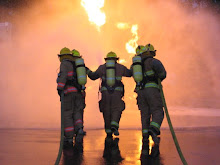
“On rope!” the firefighters yell to signal, “I am attaching/have attached myself to the rope.” It is a safety call, both for the rappelling firefighter and others on the scene. Whether working with ropes or any other fireground work, going one’s own way or doing one’s own thing—without working with others on scene—is called freelancing in the fire service. Freelancing endangers everyone.
Many of us have put lots of effort into our freelancing, going our own way, even rationalizing it all as part of a grand attempt to “help others.” We have excused our detachment for the sake of speed or urgency. Maybe we thought that working for the “common good” would somehow subsume all other “places to stand” or “lesser” anchor points. Maybe we thought this grand goal for the greater good ultimately even makes us “safer.”
I am sure that I needed to be pinned down and made to think through the problems with my approach. Stanley Hauerwas’ eloquently described some of the problems me and modernity have had in our efforts to try to stand outside of everything:
By modernity, I mean the project to create social orders that would make it possible for each person living in such orders “to have no story except the story they choose when they have no story.” That is to say, modernity is the attempt to so dis-embed and estrange peoples from the peculiarities, distinctiveness, and contingencies of their respective traditions as to form the illusion that the only story now worth telling is one entirely of their own devising. For on modernity’s terms the past as such does not truly exist, nor can it have any bearing on our present choices. Hence, the only story countenanced by modernity is one that is predicated on the false belief that since we are unencumbered by any received story, we are truly free to fashion de novo any narrative we wish and thus make (and remake) of ourselves whatever we will. (From Wilderness Wanderings: Probing Twentieth Century Theology and Philosophy, 1997, p. 26)
As our Sunday School class discussed the conflicted Corinthians and the first couple of chapters in Paul’s letter to them, it dawned on me how this modernist “be who you want to be” stuff has deranged our most common responses to conflict. Not only do we—as the conflicted—often get caught up in our freelancing, but also we—we interlocutors and responders, that is—can easily revert to our old ways of trying to appease everyone by seeking a little “common ground” among the grievances and goals. The trouble is our anchor point, or where we begin, is deemed secondary or irrelevant. As if holding some paradoxical wisdom, the popular notion is that it helps everyone to not worry about where anyone is tied off! Obviously, this gets pretty silly pretty quick.
Paul, in contrast, plainly shows where he is anchored, and one cannot miss that his pastoral exhortation is for the conflicted parties to anchor themselves here as well. Where is Paul tied off? He said,
I decided to know nothing among you except Jesus Christ, and him crucified. And I came to you in weakness and in fear and in much trembling. My speech and my proclamation were not with plausible words of wisdom, but with a demonstration of the Spirit and of power, so that your faith might rest not on human wisdom but on the power of God. 1 Cor. 2:2-5
“Christ crucified” was Paul’s anchor point, and his place to stand. Paul would have agreed with the late Quaker scholar, Elton Trueblood, who suggested that “it is here [in the trustworthiness of Jesus Christ] that the Christian finds a place to stand.”
Paul’s encouragement makes me think about how we can affiliate with Jesus and still “go our own way.” Does this “and him crucified” piece—the piece Paul makes as his only way of knowing life among these folks—tell us more about following Jesus than I’ve wanted to hear? When I sing “I have decided to follow Jesus,” do I consider where he went and how he got there? Is Paul’s specificity for his hearers giving them an anchor point for their affiliation or for their participation?
I’m glad for many lessons from the fire service. Maybe this freelancing one in particular helped me understand Stanley Hauerwas’ musing about there being “no greater compliment than to discover that you have made a mistake that truly matters,” or his prompts to begin examining my own “epistemological conceits.” (Come to think of it, Brad, one of my coworkers in the fire department, is who first turned me on to Hauerwas, loaning me Resident Aliens. Thanks, Brad!)
I have considered for some time hosting a blog, if for nothing else, to serve as a collection point for some of the fun learning and resources I’ve been blessed to find (Bear with me while I learn how to do this!). I can think of no better time than Advent and no better way to get it going than remembering to whom I’m anchored—Jesus Christ, and him crucified. May I always remember that it matters through and through--all the way down--to begin right here!
I am an eager student learning more about our Instructor and about staying in class together.
My career has been in the fire service and emergency response, and I am now back in the “seedbed” to try to grow my understanding and participation in conflict and crisis. Presently, I am studying theology and international peace and conflict in Washington, DC.
Since none of us can disentangle ourselves from our various "ropes," I want to keep mine anchored to Jesus.
I’m working on a research project to which I welcome your input and sources.The basic relationship under analysis is how identity affects care. More specifically, how does self understanding of identity affect the way individuals and groups care for others? To delineate a bit further, identity will, of course, be explored as contingent and contextual, while care is here connoting physical provision or assistance rather than simply concern or varied emotional and psychological attachments.
My program is a fun brew of theology and international affairs, so we have a wealth of variety open to draw from. Your tips and examples will be fun to explore, and they are greatly appreciated! Drop me a line here with books, articles, or simply your musings about identity and care.